

Adipotide Buy Online: Where to Find Trusted Peptide Sources
If you want to buy Adipotide online, the most important thing to understand first is what you are actually buying: the Adipotide peptide, an experimental, fat-targeting research peptide with striking preclinical results and a documented kidney-safety signal. This guide explains Adipotide's mechanism, what the animal research genuinely showed, the safety caveats, and — most importantly — how to verify a trusted source with a real Certificate of Analysis.
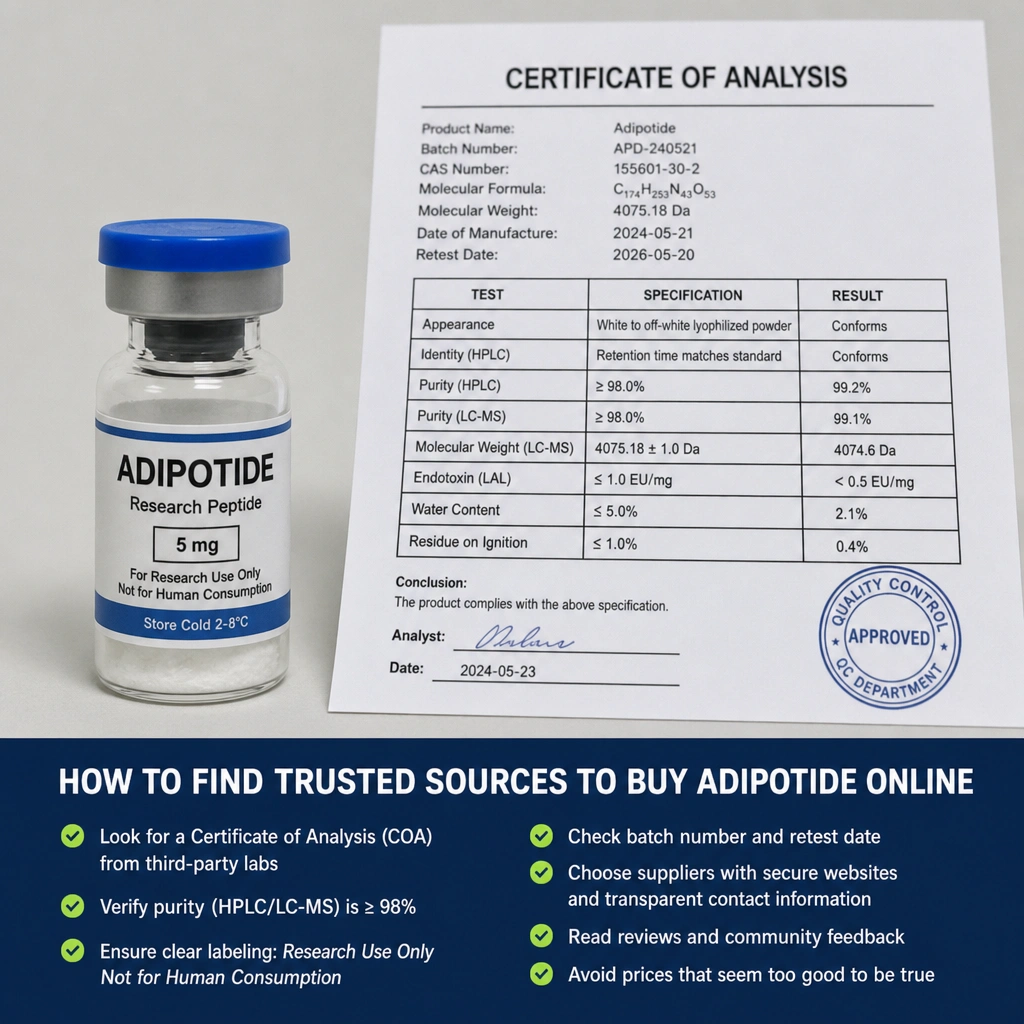
Editorial & research disclaimer: This article is for educational purposes only and is not medical advice. Adipotide is an experimental compound studied only in animals; it is not approved for human use anywhere and has documented dose-dependent kidney effects in primate research. Always consult a licensed healthcare professional and verify local regulations before handling any peptide.

Quick Answer
Where can you buy Adipotide safely? Only from research-peptide suppliers that publish a current, batch-matched COA with 99%+ HPLC purity and are independent third-party tested, label the product for laboratory research use only, and ship lyophilized powder vials cold. Adipotide is not an approved drug — it is an experimental, animal-stage compound, so supplier transparency is everything.
Critically, Adipotide caused dose-dependent kidney effects in primate studies. Anyone evaluating it should weigh that documented safety signal and the complete absence of human trials before proceeding.
Adipotide (FTPP) is an experimental synthetic peptidomimetic that targets the blood supply of white fat tissue.
Mechanism: it homes to prohibitin on fat-feeding blood vessels and triggers apoptosis, cutting off the vessels that nourish fat.
Evidence: a 2011 rhesus-monkey study showed weight loss — but only in animals, with no completed human trials.
Safety caveat: dose-dependent kidney effects were observed in primates; this is a serious limitation, not a footnote.
Buy on proof: batch-specific COA, 99%+ HPLC purity, third-party testing, cold-chain shipping, research-use-only labeling.
What Is Adipotide?
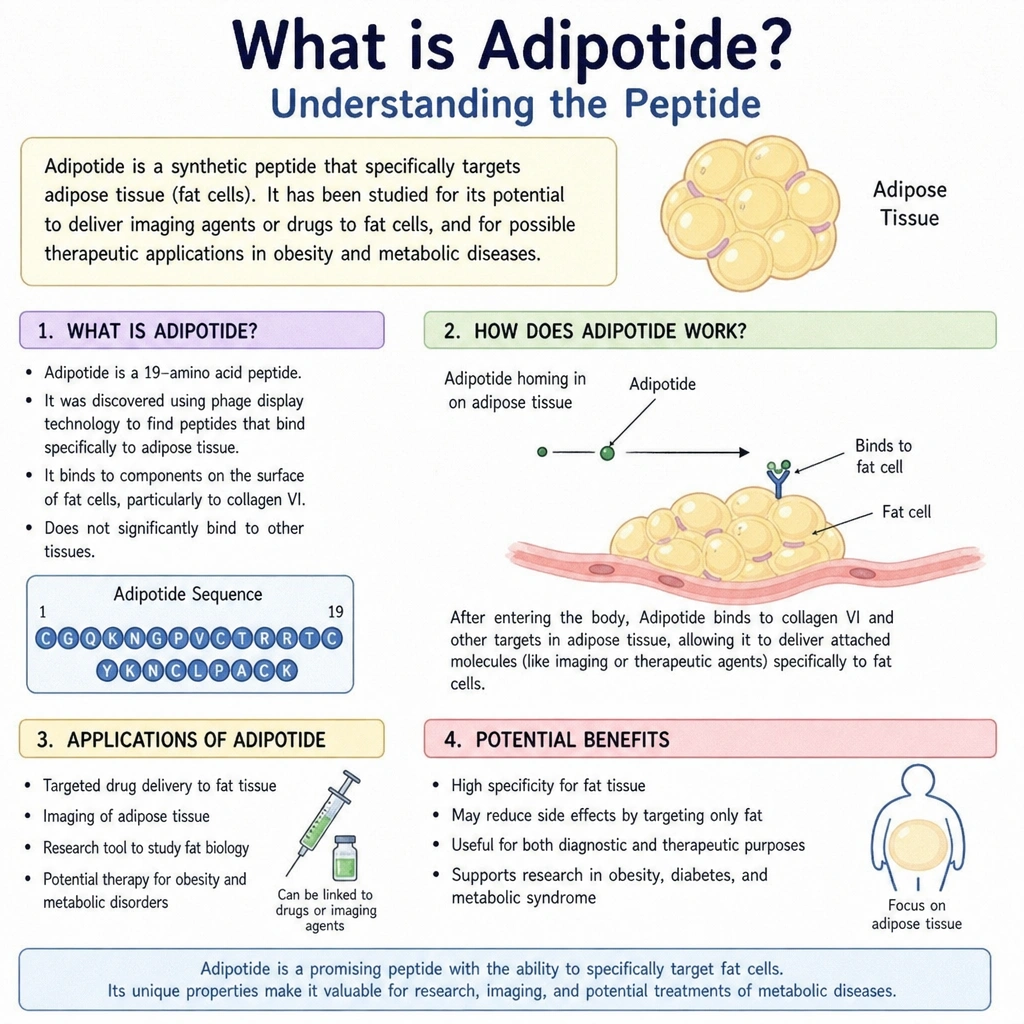
Adipotide (also called FTPP or Prohibitin-TP01, a “fat-targeted proapoptotic peptide” with a specific molecular formula: c 152 h 252 n 44 o 42, and a molecular weight: 2611.41 g/mol) is an experimental peptidomimetic designed to reduce fat tissue by a novel route: instead of altering appetite or metabolism, it targets the blood vessels that supply white adipose tissue. It pairs a homing sequence that recognizes prohibitin on fat-vessel lining with a proapoptotic segment, often identified as D(KLAKLAK)2, that triggers programmed cell death in those vessels.
- Targets the vasculature feeding white fat tissue, not fat cells directly.
- Induces apoptosis in those blood vessels, starving the fat depot.
- Developed strictly for research and experimental purposes.
- Not approved for human use; studied primarily in animal models.
- Showed weight and fat reduction in preclinical primate work — with notable safety caveats.
How Does Adipotide Work? Mechanism and Effects
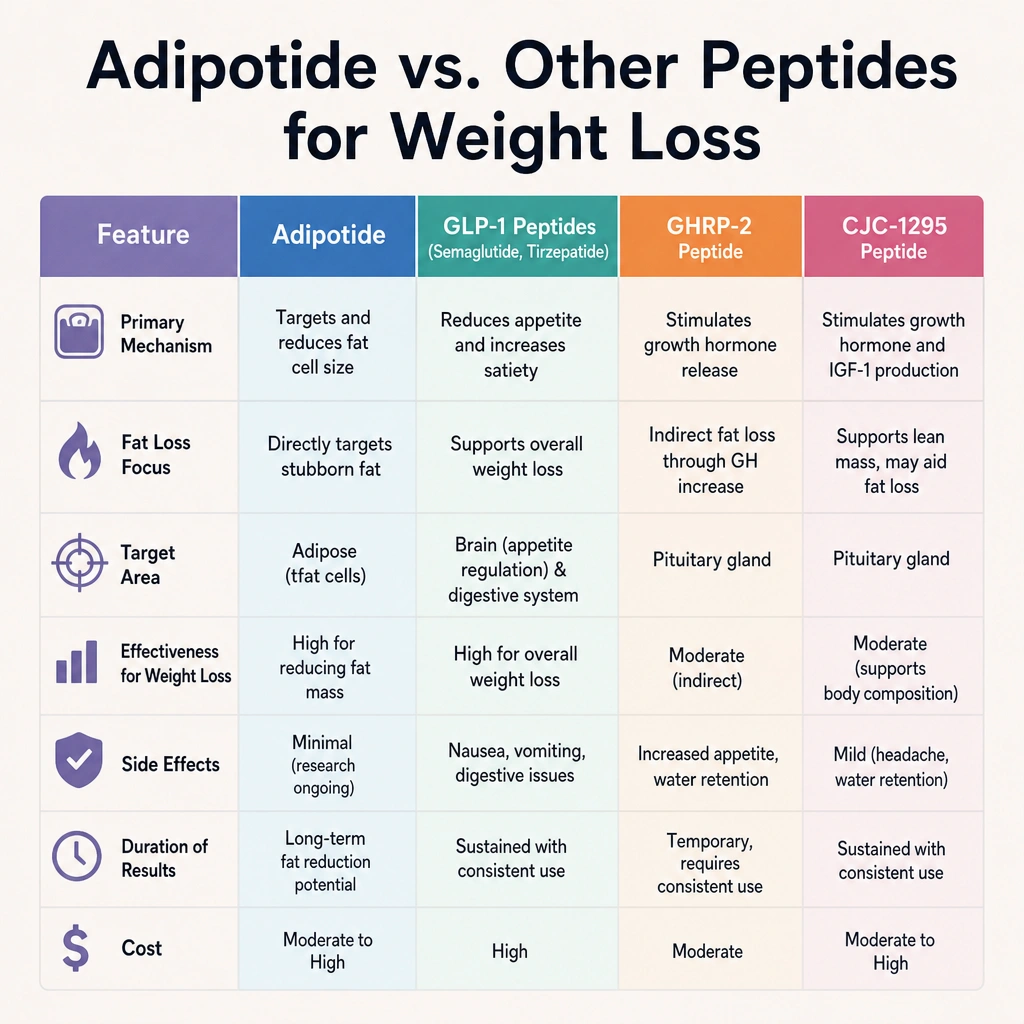
White fat depots depend on a dedicated blood supply. Adipotide's homing peptide recognizes prohibitin and and annexin a2 (also known as anxa2), proteins enriched on the surface of the endothelial cells lining fat-feeding vessels. Once bound, the attached proapoptotic domain disrupts those cells' mitochondrial membranes and triggers apoptosis. With the local blood supply withdrawn, the fat depot shrinks. The approach is sometimes described as targeting fat the way anti-angiogenic strategies target tumors, differing significantly from the lipolytic mechanism of AOD-9604, the tissue-repair properties of bpc-157, or the growth hormone-releasing effects of Tesamorelin and Ipamorelin.
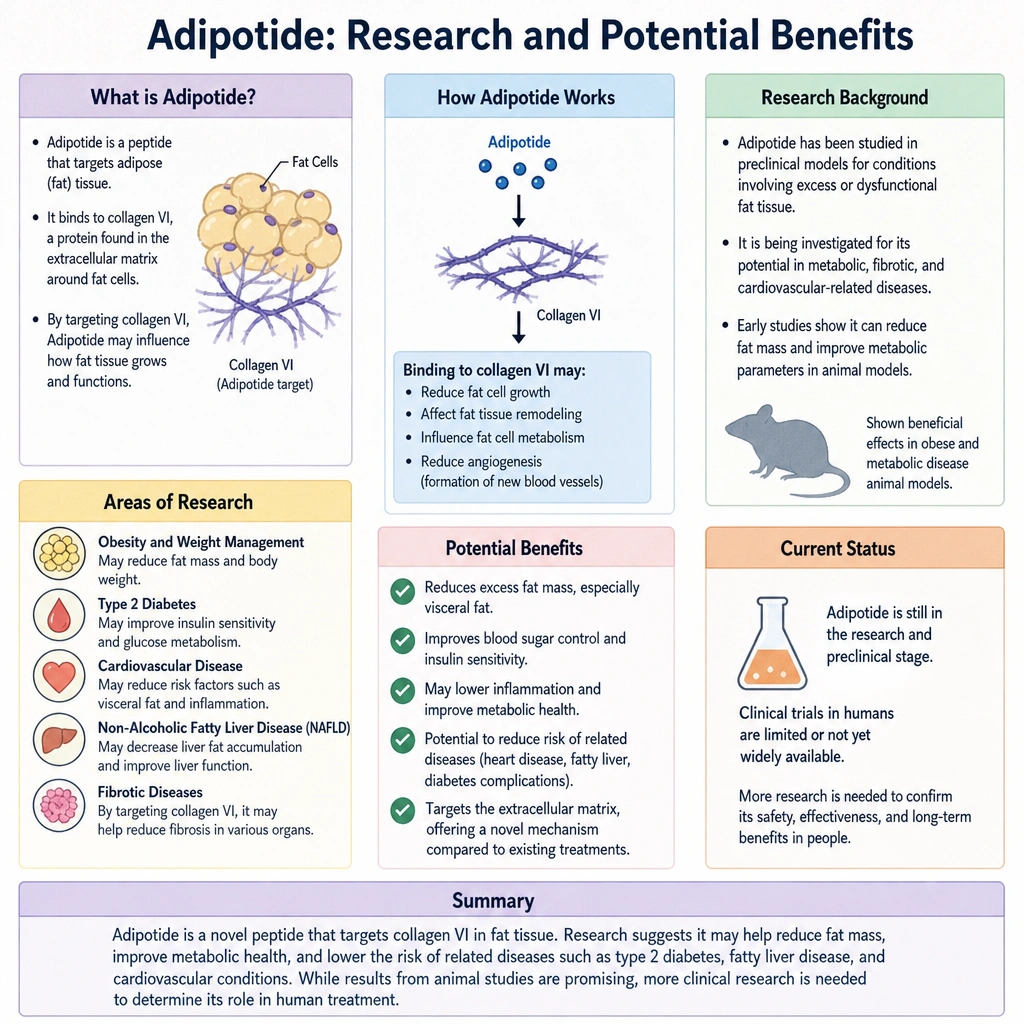
Reported effects in animal studies include reductions in body and visceral fat and improvements in some metabolic markers, including fatty acid transport, adiponectin levels, insulin sensitivity, and glucose tolerance. But the same research flagged effects on kidney function — the basis for the safety concerns discussed below.
What Does the Research Actually Show?
The headline result that put Adipotide on the map was a 2011 study in obese rhesus monkeys (Barnhart and colleagues, published in Science Translational Medicine), in which treated animals lost a meaningful percentage of body weight along with improvements in metabolic measures like leptin levels. It was a genuinely interesting proof of concept for vasculature-targeted fat loss.
The crucial context: that work was in animals, and the same and subsequent research observed dose-dependent kidney effects (including changes consistent with renal stress). No completed, published human clinical trials have established efficacy or safety. In other words, the exciting result and the serious caveat come from the same body of preclinical evidence — you cannot accept one and ignore the other.
The honest limitation: Adipotide remains experimental and unapproved. Claims that it is a proven or safe weight-loss treatment for humans are not supported by the evidence.
Safety Considerations You Cannot Skip
Adipotide is one of the clearest examples of why “it worked in a study” is not the same as “it is safe.” The documented renal signal in primate research is the central safety issue, and the human risk profile is simply unknown because human trials have not been completed.
- Kidney effects were dose-dependent in primate studies — the primary documented concern.
- No human safety data exist from completed clinical trials.
- Experimental status means no regulatory oversight of quality or use.
- Self-experimentation is high-risk and outside any approved medical framework.
How to Verify a Trusted Adipotide Source
Because Adipotide is unregulated, the only protection a buyer has is documentation. Verify these before purchasing:
| Factor | Trusted (Verified) | Untrustworthy |
|---|---|---|
| Purity | 99%+ by HPLC, identity confirmed | Unverified, self-reported, or below 95% |
| COA | Batch-specific, recent, third-party lab | Missing, generic, undated, or photocopied |
| Manufacturing | Cleanroom, validated lyophilization | Sterility & environment unclear |
| Labeling | Clear “research use only” | Consumer weight-loss claims |
| Shipping | Cold-chain where required | Ambient; degradation risk |
| Support | US-based, real address | Anonymous / offshore |
Where to Buy Adipotide Online Safely
Realistically there are three channels, but for an experimental compound like Adipotide, a dedicated research-peptide or research chemical supplier that meets the COA standard above is the only sensible option — and only for legitimate research use.
| Channel | Selection | Oversight | Best for |
|---|---|---|---|
| Research-peptide suppliers | Specialized; experimental compounds | COA-driven; varies by vendor | Verified research use only |
| Licensed pharmacies / clinics | Will not stock Adipotide | High; professional oversight | Approved compounds only |
| General online marketplaces | Unvetted, high risk | Very low | Not recommended |
Wherever you look, the checklist is fixed: COA + HPLC purity + lyophilization + cold-chain + batch traceability. If any are missing, the listing is not trustworthy. PrymaLab's research peptide catalog, featuring compounds like GHRP-2, illustrates the transparency standards to expect.
Researching experimental peptides? Demand proof, not hype.
PrymaLab focuses on transparent, batch-specific COAs and cold-chain shipping so every research vial is exactly what the label says.
Explore PrymaLab Research PeptidesFrequently Asked Questions
Where can I buy Adipotide online safely?
Only from research-peptide suppliers that publish a current, batch-matched Certificate of Analysis with 99%+ HPLC purity and independent third-party testing, label the product research-use-only, and ship lyophilized vials cold. Adipotide is an experimental, unapproved compound, so supplier transparency and documentation are the only real protection a buyer has.
What is Adipotide and how does it work?
Adipotide (FTPP) is an experimental peptidomimetic that targets the blood vessels supplying white fat tissue. A homing sequence binds prohibitin on those vessels and a proapoptotic segment triggers their death, cutting off the fat depot's blood supply. It is studied only in animals and is not approved for human use.
Is Adipotide safe?
No human safety has been established — there are no completed human clinical trials. Primate research showed dose-dependent kidney effects, which is the central documented safety concern. Adipotide remains an experimental compound, and self-experimentation falls outside any approved medical framework and carries real risk.
What did the Adipotide research actually show?
The best-known study (obese rhesus monkeys, 2011, Science Translational Medicine) showed meaningful weight loss and some metabolic improvements — but only in animals, and the same body of work flagged kidney effects. No human efficacy or safety has been demonstrated, so the result is a proof of concept, not evidence of a safe human treatment.
Is Adipotide legal to buy?
Adipotide is sold as a research compound and is not approved for human therapeutic use anywhere. Laws vary by country and state, and some regions restrict experimental peptides. Confirm your local regulations before purchasing, and buy only from suppliers that clearly label the product for research use only.
What purity should Adipotide have?
Research-grade Adipotide should test at Purity: >99% by HPLC with identity and molecular weight confirmation on a batch-specific COA from an independent lab. Anything below 98% is a yellow flag and below 95% is a hard pass. A generic, undated purity claim without a chromatogram is not acceptable.
What are the red flags of an untrustworthy Adipotide seller?
Watch for missing or unverifiable third-party COAs, prices far below market, consumer weight-loss marketing on a research compound, anonymous ownership with no US address, no return policy, and sloppy packaging. Mixing therapeutic claims with research-only labeling is a particular warning sign.
How should I store Adipotide?
Keep lyophilized Adipotide cold and dark; refrigerate or freeze unopened vials. After reconstitution with bacteriostatic water, store refrigerated, protect from light and heat, and use within the supplier's stated window. Use sterile technique, and follow the supplier's handling instructions.
References & Further Reading
- Barnhart, K.F., et al. (2011). A peptidomimetic targeting white fat causes weight loss and improved insulin resistance in obese monkeys. Science Translational Medicine, 3(108), 108ra112.
- Kolonin, M.G., Saha, P.K., Chan, L., Pasqualini, R., & Arap, W. (2004). Reversal of obesity by targeted ablation of adipose tissue. Nature Medicine, 10(6), 625–632.
- Staquicini, F.I., et al. Vascular-targeting peptides and prohibitin biology (review literature).
- U.S. Food and Drug Administration. Compounding and the FDA: Questions and Answers. FDA.gov. Accessed 2026.
- United States Pharmacopeia. General Chapter <1225>: Validation of Compendial Procedures (HPLC principles).
PrymaLab resources: Bioregulator peptides · Research Hub · Peptide calculator · FAQ · About PrymaLab.
Final disclaimer: This article is for educational purposes only. Adipotide and the other compounds discussed are sold for research purposes only and are not approved by the FDA or comparable agencies for human therapeutic use. Statements about their effects have not been evaluated by the FDA.
Always consult a licensed healthcare professional before starting any new health protocol, and verify the legal status of any compound in your jurisdiction. PrymaLab does not endorse any specific third-party peptide vendor mentioned in this article and assumes no responsibility for third-party products.